 ync
yncWho is the water-sampling module for?
Same flow — register, import lab results, assess, report — but the key figure adapts to the operation:
| OPERATION | KEY FIGURE | TYPICAL SETUP |
|---|---|---|
| Car wash | Emissions per 12 m unit | Municipal limit values, sampling in the winter half-year, report to the environmental authority — see the table below. |
| Workshop & industry | Per produced unit or custom key figure | Emissions spread per produced unit, or compared directly against a guideline or limit value in a permit or utility agreement. |
| Sampling contractors | Optional, per client | Sampling on behalf of several operations: each client gets their own sites, limit values, schedules and finished reports. |
| Property & other | Straight against a guideline value | Oil separators, wash pads and other points where the lab value is compared as-is, with measurement uncertainty included. |
Car washes: what applies to your site?
There are no national limit values for car washes in Sweden. The Swedish Environmental Protection Agency issues supervisory guidance, but it is the municipality or water utility that decides what applies where you are — and the differences are bigger than most operators expect.
If you wash more than 5,000 passenger cars per year the operation is notifiable to the municipality. Below that threshold you may still fall under the water utility's guidelines for discharge to sewer.
Four examples of how different this looks (verified August 2026):
| MUNICIPALITY / UTILITY | SAMPLING | REPORT DUE |
|---|---|---|
| Stockholm Vatten och Avfall | Over 5,000 cars/year: weekly composite samples during two separate months, November–April. 2,000–5,000 cars/year: at least one 24-hour composite sample, November–April. | 31 May |
| Umeå municipality | Notifiable operations: at least once a year, November–April, by an accredited sampler. | To the environment and health committee |
| Kalmar municipality | One to two times a year, December–April, as flow-proportional composite samples. Documentation kept for five years. | 31 May |
| Håbo municipality | Notifiable operations every year, medium-sized sites every second year. November–March. | 30 April |
Note Håbo: a month earlier than most. If you run sites in several municipalities, that is exactly the kind of detail that is easy to miss — and hard to build into a spreadsheet.
Always check what applies with your own supervisory authority. Guidelines are revised, and as the operator you are responsible for following them.
Three things that go wrong in Excel
Measurement uncertainty
The lab reports a value and a measurement uncertainty — for example 0.45 mg/l ± 20 %. If the limit value is 0.5 mg/l, are you compliant? The answer depends on how measurement uncertainty is handled in the assessment, and it is precisely that judgement that becomes arbitrary when it is made by hand once a year by whoever happens to have time.
Conversion to 12 m units
Limit values are given per vehicle unit, not per litre of water. Heavy vehicles are converted to 12-metre units, so a rig with a trailer counts as more than one vehicle. With mixed traffic through the hall, the count has to be converted before concentrations can be compared against the limit value. Get the conversion wrong and you get the wrong answer even when the lab analysis is perfectly correct.
In FieldSync the key figure is also optional: per 12 m unit for car washes, per produced unit in a factory, or directly against a guideline or limit value with no conversion.
Several sites
Two halls in two municipalities means two rule sets, two sampling windows and two deadlines. With seven halls it is seven. Excel can handle it — but only as long as the person who built the sheet still works there and remembers how it was meant to work.
How FieldSync works
- Register the sampling. Date, sample type, sampler and the number of vehicles washed during the period. Straight from the phone when the sample is taken, not afterwards.
- Import the lab PDF. Upload the result from the lab. FieldSync reads out parameters, concentrations and measurement uncertainty automatically.
- Get the assessment. Concentrations are converted to emissions per 12 m unit and compared against the limit values that apply to your specific site, with measurement uncertainty included. You see immediately what is below, above and close to the limit.
- Send the report. A finished submission for the environmental authority, and a history that stays. When an inspector asks for three years back, answering takes seconds instead of an evening in your inbox.
Hard to fill in wrong
FieldSync makes sure everything gets filled in — and that the maths is right. Required fields mean sampling cannot be completed with gaps: date, sample type, number of vehicles washed and measured values must all be in place before anything can be signed. Conversion to 12 m units, water consumption and the comparison against the limit value are calculated by the system, not by whoever is filling in — the same inputs always give the same answer, and implausible values are flagged at entry. The goal is simple: make it as hard as possible for a technician to fill in wrong.
What the report looks like
The assessment lands in a finished sample report: each parameter with measured concentration, amount per 12 m unit, limit value, measurement uncertainty and a clear verdict.
| PARAMETER | CONC. | AMOUNT/12M | LIMIT VALUE | UNCERT. | VERDICT |
|---|---|---|---|---|---|
| Lead (Pb) | 0.012 mg/l | 1.9 mg | 5 mg | ±15 % | WITHIN LIMIT |
| Zinc (Zn) | 0.48 mg/l | 46 mg | 50 mg | ±20 % | WITHIN UNCERTAINTY |
| Oil index | 4.2 mg/l | 640 mg | 500 mg | ±25 % | EXCEEDED |
Example with fictional values — your report uses your municipality's limit values and parameters.
Filling in from the field
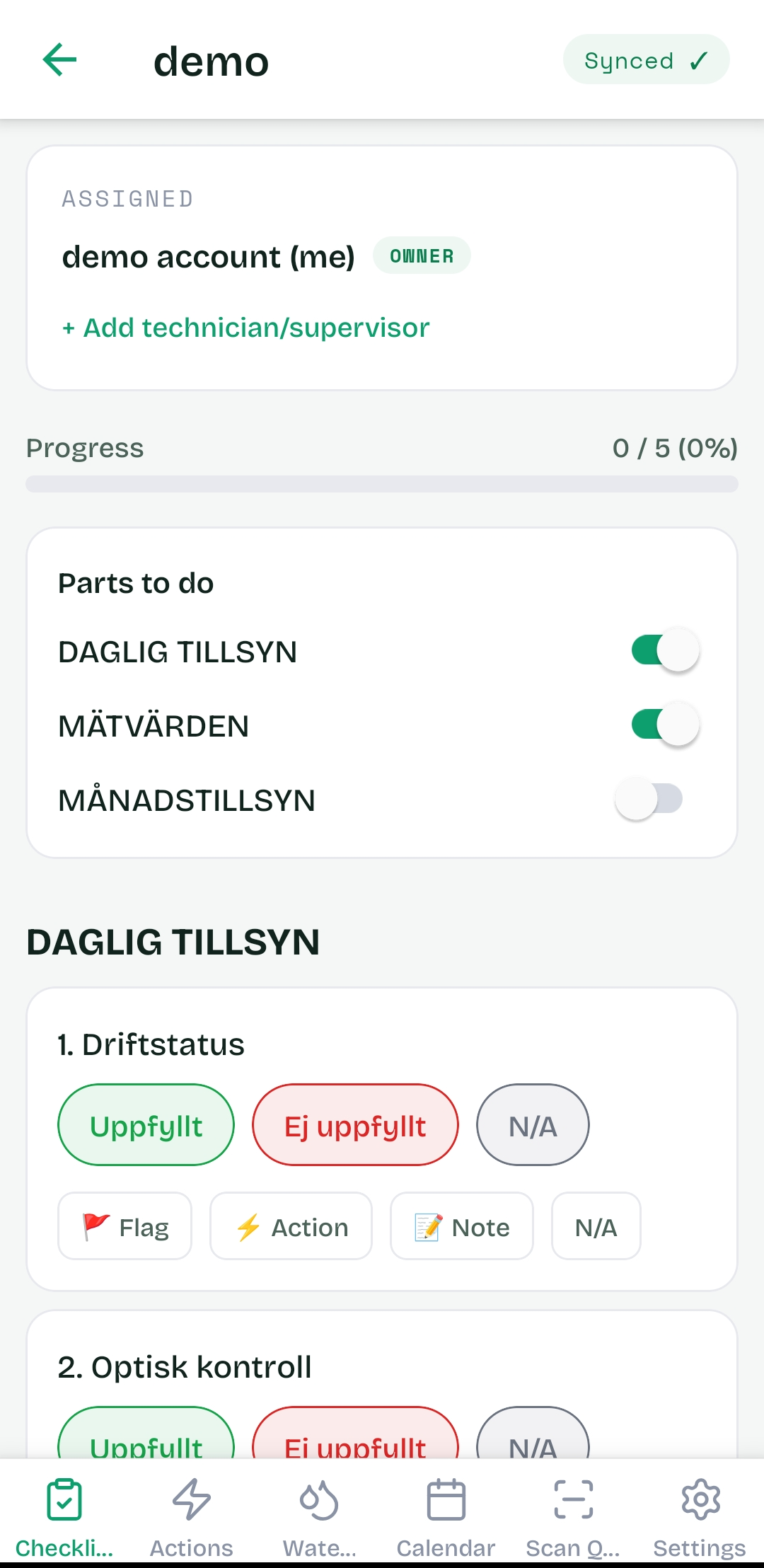
The technician registers straight on the phone when the sample is taken — fully offline too. The done button stays unavailable until every required field checks out.
What it costs
Water sampling is an add-on module at €15 per month per company — a flat price regardless of the number of sites, on top of your FieldSync plan:
- Standard: €20 per technician per month (1 admin + 1 manager included free).
- Lite: €10 per month flat for teams up to 4 people — the whole product, with a fair-use cap.
So a sampling contractor with two samplers pays €40 + €15 = €55/month; a small wash hall on Lite pays €10 + €15 = €25/month. No lock-in and no installation. Full price list.
Frequently asked questions
When should the sample be taken?
Most municipalities require sampling during the winter half-year, typically November to April, because road pollution load is highest then. The exact window and number of samples is set by your municipality.
Does the sampler have to be accredited?
In several municipalities, including Umeå, yes. Others accept that the operator takes the sample themselves following instructions. Your municipality's guidelines state which applies.
What is a flow-proportional composite sample?
A sample drawn in proportion to water flow over a period, rather than a grab sample at a single moment. It gives a more representative picture of what is actually discharged during operation, and is what municipalities most often ask for.
How long must documentation be kept?
It varies. Kalmar requires five years. Expect to be able to show several years back during an inspection — which is also why loose PDFs in an inbox are a poor archive.
We have an oil separator, isn't that enough?
No. The oil separator is part of the treatment and has its own inspection and emptying requirements, but it does not replace sampling of the outgoing water. Both are part of self-inspection.
Does it work for anything other than car washes?
Yes. The key figure is optional: car washes calculate emissions per 12 m unit, a factory can calculate per produced unit instead, and values can also be compared directly against a guideline or limit value with no conversion.
We are a sampling contractor — can we use FieldSync for our clients?
Yes. Set up each client with their own sites, limit values and sampling schedules. You register samples out at the client, import the lab results and deliver finished, signed reports — with all history kept per client.
Can I use FieldSync for several sites?
Yes. Each site gets its own limit values, its own sampling schedule and its own history, so the right requirements follow the right hall.
Getting started
Send us a lab report from last season and we will run it through the system and show you what comes out — before you decide anything. Book a demo, the first month is free.
Sources
- Swedish EPA — Vehicle washes (Swedish)
- Stockholm Vatten och Avfall — Guidelines for vehicle-related operations (2025-09)
- Umeå municipality — Vehicle washes
- Kalmar municipality — Guidelines for car washes
- Håbo municipality — Vehicle washes
The municipal details in the table were verified against the sources above in August 2026. Guidelines are revised — always check with your own supervisory authority.
Read more
- Shared inspections — several people on one checklist, stamped per line.
- Checklist app for business — the five requirements that decide in field work.
- Comparing inspection apps — six questions to ask every vendor.
- Digital self-inspection · Water sampling